
Blog
50 Questions Asked About Kids Wetsuits – Answered by the NCW Experts
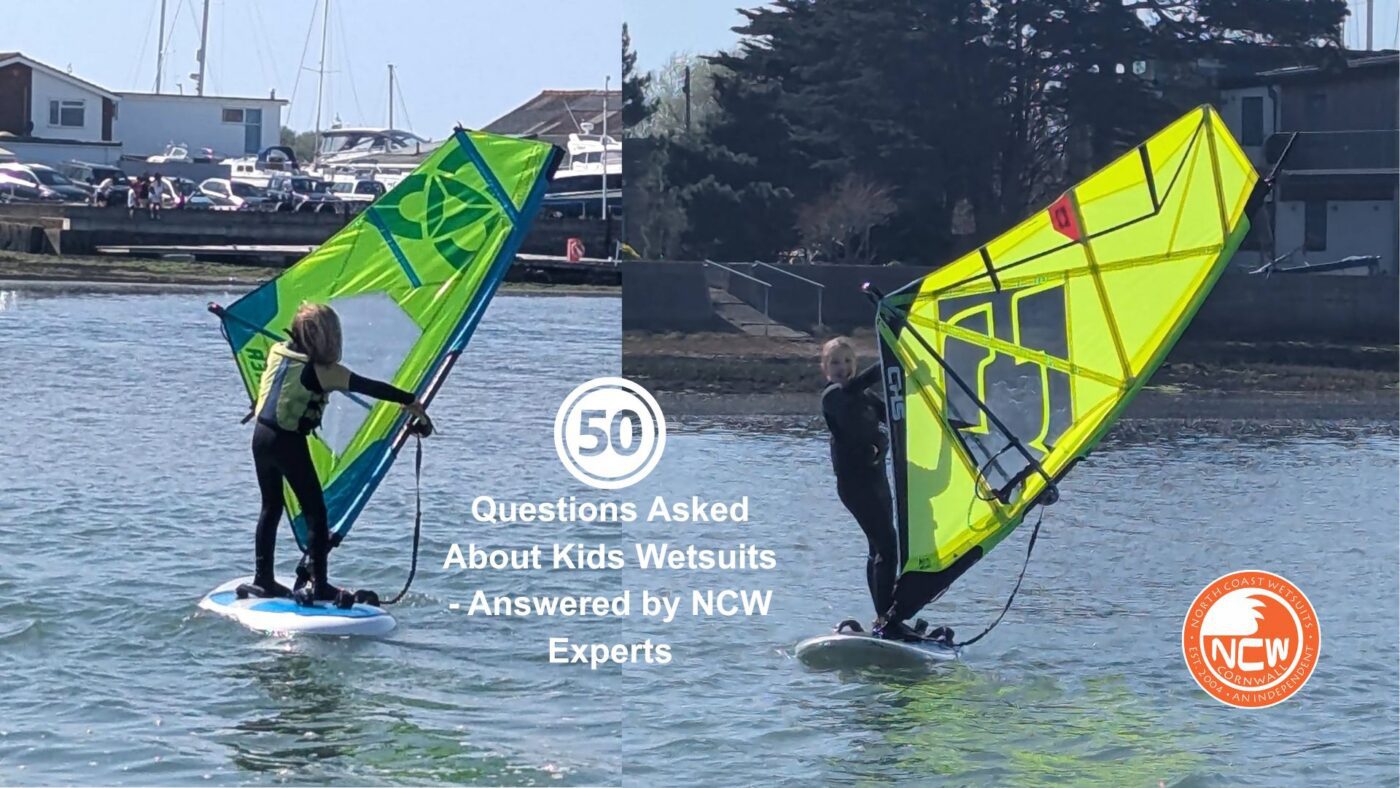
What thickness wetsuit does my child need? Can kids wear a 5/4mm wetsuit in summer? How should a kids’ wetsuit fit? And how do you know when your child is getting too cold?
Table of Contents
Kids Wetsuit Choices – Not Always Straightforward
Choosing a wetsuit for a child isn’t always straightforward. Children’s needs can be very different from those of adults, and water temperature isn’t the only thing that determines whether a child will feel cold.
At North Coast Wetsuits (NCW), we’re experts in wetsuits for young water users. We know that kids can get cold quickly, particularly when they’re sitting around between waves, spending long periods in the water or dealing with wind and spray.
That’s why many children wear thicker wetsuits than you might expect for the conditions. A 5/4mm kids’ wetsuit isn’t necessarily just a winter wetsuit. Depending on the child, the activity and the conditions, it can be a great option during autumn, spring and even cooler UK summer days.
We’ve answered 50 of the most common questions parents ask about kids’ wetsuits.

Kids wetsuits
1. What is the best wetsuit thickness for kids?
There isn’t one thickness that’s right for every child or every season.
The correct wetsuit depends on water temperature, air temperature, wind, activity level, how long your child will be in the water and how susceptible they are to getting cold.
For UK waters, children’s wetsuits can range from thinner summer suits through to 5/4mm winter wetsuits.
At NCW, we’d rather see a child comfortably warm in a suit that’s slightly thicker than necessary than struggling through a session because they’re cold.
2. What thickness wetsuit does my child need for summer?
This is one of the questions we get asked most often.
A traditional answer might be a 2mm or 3/2mm wetsuit for summer. However, summer doesn’t automatically mean warm water, particularly in the UK.
Many children wear 3/2mm, 4/3mm or even 5/4mm wetsuits during summer, depending on the conditions and how easily they get cold.
Children can lose body heat more quickly than adults, so a thicker wetsuit can sometimes be the better choice even when the weather looks like summer.
3. Can kids wear a 5/4mm wetsuit in summer?
Absolutely.
A 5/4mm wetsuit isn’t exclusively for winter.
If the water is cool, the wind is blowing, the session is long or your child gets cold easily, a 5/4mm suit can provide welcome additional insulation.
This is particularly relevant in the UK, where air temperatures can feel warm while the sea remains relatively cold.
If your child is comfortable, not overheating and has suitable freedom of movement, there’s nothing inherently wrong with choosing a thicker wetsuit for summer.
4. Why do some kids wear thicker wetsuits than adults?
Children can feel the cold differently from adults.
They may spend longer immersed in the water, sit waiting for waves, have less body mass and become cold without necessarily telling you immediately.
A child who gets cold easily may therefore benefit from more neoprene and greater thermal protection than an adult would choose for exactly the same conditions.
5. What wetsuit should kids wear in autumn?
Autumn is when conditions can change quickly.
A 3/2mm or 4/3mm wetsuit can work well during the early part of autumn, while colder conditions may call for a 5/4mm suit.
For children who get cold easily, moving into a thicker wetsuit earlier in the season can make sessions much more enjoyable.
Don’t judge the water temperature purely by the sunshine.
6. What wetsuit should kids wear in winter?
For cold UK waters, a 5/4mm winter wetsuit is a common choice.
Depending on conditions, children may also need:
- Wetsuit boots
- Wetsuit gloves
- A hood
- Appropriate thermal layers
The colder the water becomes, the more important the complete equipment setup becomes.
7. How do I know if my child’s wetsuit is too thin?
If your child regularly complains about being cold, starts shivering, becomes reluctant to get back into the water or seems unusually tired during a session, their wetsuit may not be providing enough insulation.
Consider:
- Water temperature
- Air temperature
- Wind
- Session duration
- Wetsuit thickness
- Whether hands, feet and head are protected
If your child is consistently cold, don’t simply accept it as part of watersports. Reconsider the equipment and conditions.
8. How tight should a kids’ wetsuit be?
A wetsuit should fit snugly without restricting movement or breathing.
Some compression is normal. The suit needs to sit close to the body to provide effective insulation.
However, it shouldn’t be painfully tight or restrict paddling, swimming, surfing or other movements.
9. Should I buy a wetsuit bigger so my child can grow into it?
It’s tempting because children grow quickly.
However, deliberately buying a wetsuit that’s several sizes too large can compromise its ability to keep your child warm.
Water can flush through gaps around the neck, wrists and ankles.
Buy the correct size wherever possible and choose a suit that provides some room for natural growth without being excessively loose.
10. How can I tell whether my child’s wetsuit fits properly?
Check:
Body: The neoprene should sit close to the torso.
Arms and legs: There shouldn’t be excessive loose material.
Neck: It should form a comfortable seal.
Back/zipper: The suit should sit correctly without excessive stretching.
Movement: Your child should be able to paddle, swim, surf and move naturally.
A good wetsuit should feel like a second skin rather than a suit they’re fighting against.
11. Can kids wear adult wetsuits?
They can, but a properly designed kids’ wetsuit is usually the better option.
Children have different body proportions from adults, particularly around the torso, arms and legs.
A kids’ wetsuit is designed to accommodate those proportions and provide an appropriate balance between warmth, flexibility and comfort.
12. Are kids’ wetsuits different from adult wetsuits?
Yes.
Kids’ wetsuits are designed around children’s proportions and requirements.
They also need to allow plenty of movement because young water users may be surfing, swimming, bodyboarding, paddleboarding, kayaking or taking part in several activities during the same session.
13. Does my child need a wetsuit for surfing?
In UK waters, a wetsuit is generally essential for comfortable surfing outside the warmest conditions.
The correct suit helps reduce heat loss and can allow children to stay comfortable for longer.
For younger surfers, staying warm can also make the difference between enjoying a session and wanting to get out after only a few minutes.
14. Do kids need wetsuits for paddleboarding?
A wetsuit can be very useful for paddleboarding, particularly when the water is cold or there’s a realistic possibility of falling in.
Remember that paddleboarding involves a mixture of being on the board and potentially spending time in the water.
Always consider the complete safety setup for the conditions.
15. Does my child need a wetsuit for bodyboarding?
For UK bodyboarding, a wetsuit is highly recommended outside the warmest conditions.
Bodyboarders spend a lot of time in the water and can be repeatedly immersed by waves.
A suitable wetsuit provides thermal protection while allowing the movement required to catch waves.
16. Can kids swim in wetsuits?
Yes.
Wetsuits are widely used for open-water swimming and other water activities.
The suit should fit correctly and provide sufficient flexibility for the type of swimming being undertaken.
17. Do wetsuits keep kids warm?
Yes. That’s their primary purpose.
Wetsuit neoprene provides insulation and helps reduce the rate at which body heat is lost.
However, a wetsuit isn’t a guarantee that a child won’t become cold. Conditions, session length and the individual child all matter.
18. How does a wetsuit actually keep a child warm?
Neoprene contains tiny gas cells that provide insulation.
A wetsuit also allows a thin layer of water to sit between the body and neoprene. The body warms this layer while the neoprene helps slow heat loss.
This is why a close, appropriate fit is so important.
19. Does thicker neoprene always mean warmer?
Not necessarily.
Thickness is important, but warmth also depends on:
- Fit
- Neoprene quality
- Seams
- Construction
- Wind protection
- Coverage
- Internal lining
- Accessories such as boots, gloves and hoods
A thicker wetsuit can provide additional insulation, but it still needs to fit properly.
20. What is a 3/2mm kids’ wetsuit?
A 3/2mm wetsuit uses different neoprene thicknesses in different parts of the suit.
Typically, 3mm neoprene is used through the main body, with 2mm material in areas where flexibility is particularly important.
It’s a popular choice for warmer conditions.
21. What is a 4/3mm kids’ wetsuit?
A 4/3mm wetsuit generally uses 4mm neoprene around the torso and 3mm in areas requiring greater flexibility.
It provides more insulation than a typical 3/2mm and can be useful as temperatures fall.
22. What is a 5/4mm kids’ wetsuit?
A 5/4mm wetsuit is designed to provide substantial thermal protection in colder water.
It’s commonly associated with winter surfing, but there’s no rule saying it can’t be worn during other seasons.
For children who feel the cold, a 5/4mm can be useful during cooler spring and summer sessions too.
23. Is a 5/4mm wetsuit too hot for summer?
Not automatically.
The answer depends on the actual conditions and the individual child.
A warm, sunny, windless day may make a 5/4mm uncomfortable, particularly when your child is out of the water.
But a cool, windy summer day with cold sea temperatures can be perfectly suitable for a thicker wetsuit.
The important thing is to monitor your child rather than choosing thickness based purely on the calendar.
24. Should my child have a different wetsuit for summer and winter?
Ideally, having different suits can give greater flexibility.
For example:
- Summer: 2mm–3/2mm
- Spring/autumn: 3/2mm–4/3mm
- Winter: 5/4mm
But this isn’t a rigid rule.
If your child gets cold easily, a 4/3mm or 5/4mm may be useful outside winter, while some children may be comfortable in thinner suits.
25. Does my child need a hooded wetsuit?
A hooded wetsuit can be very useful in cold conditions.
It provides additional insulation around the head and neck and can make a significant difference during winter sessions.
26. Do kids need wetsuit boots?
Boots provide:
- Warmth
- Protection
- Grip
- Additional comfort
They’re particularly useful in colder water and when children are walking over rocks, beaches or other potentially rough surfaces.
27. Do kids need wetsuit gloves?
Gloves can make a significant difference when water temperatures fall.
Cold hands can quickly become uncomfortable and can affect dexterity and enjoyment.
28. Should kids wear wetsuit gloves in summer?
Usually not.
However, if the water is unusually cold, your child feels the cold easily or they’re undertaking a long session, additional hand protection may still be appropriate.
29. Can my child wear a rash vest under their wetsuit?
Yes.
A rash vest can improve comfort and reduce rubbing.
In colder conditions, an appropriate thermal layer can also provide additional insulation.
30. What should kids wear under a wetsuit?
A swimsuit, swimming costume or rash vest is usually sufficient.
In colder conditions, an appropriate thermal layer may be useful.
Avoid bulky clothing because it can interfere with the wetsuit’s fit.
31. Can kids wear wetsuits all day?
They can wear them for extended periods, but they don’t necessarily need to remain in the suit when they’re out of the water.
On warm days, a thick wetsuit can become uncomfortable or cause overheating when your child is standing around on the beach.
Take the suit off or unzip it when appropriate and allow your child to cool down.
32. Can a child overheat in a wetsuit?
Yes.
A wetsuit reduces heat loss, which is exactly what you want in cold water. But that same insulation can make children hot when they’re out of the water in warm weather.
This is another reason why a 5/4mm wetsuit in summer needs to be judged by conditions rather than simply being labelled a winter suit.
33. How long can kids stay in the water wearing a wetsuit?
There’s no universal time limit.
It depends on:
- Water temperature
- Air temperature
- Wind
- Wetsuit thickness
- Child’s age and size
- Activity level
- Session duration
- Individual tolerance
A wetsuit should never be treated as permission to stay in cold water indefinitely.
34. How do I know if my child is getting too cold?
Look for:
- Shivering
- Complaints about being very cold
- Pale or cold skin
- Loss of coordination
- Unusual tiredness
- Slower responses
- Reluctance to continue
If you’re concerned, get your child out of the water and warm them up.
35. Can kids surf when the water is very cold?
Yes, provided they’re properly equipped and the conditions are appropriate for their ability.
Cold-water surfing requires more consideration than simply putting on a thicker wetsuit.
Think about the complete setup:
Wetsuit + boots + gloves + hood + appropriate conditions + sensible session length.
36. Is cold water dangerous for children?
Cold water deserves respect.
Children can become cold relatively quickly, particularly during prolonged immersion.
There is also the risk of cold shock when entering very cold water.
Parents should always assess the conditions and supervise children appropriately.
37. What is cold shock?
Cold shock is the body’s immediate response to sudden immersion in cold water.
It can cause an involuntary gasp and rapid changes in breathing.
This is particularly important if a child unexpectedly falls into cold water.
38. Should kids surf in winter?
They can, provided they’re appropriately equipped and the conditions are suitable for their ability.
Winter sessions require more preparation because both water and air temperatures can be significantly lower.
If conditions aren’t suitable, don’t force the session.
39. Should kids surf in summer in a 5/4mm wetsuit?
Yes, in the right circumstances.
If the sea remains cool, the wind is strong or your child gets cold easily, a 5/4mm wetsuit can provide additional comfort and warmth.
At NCW, we see plenty of young water users who prefer the extra warmth of a thicker suit even during summer.
The priority should always be your child’s comfort and the conditions rather than what season it happens to be.
40. What happens if my child’s wetsuit is too small?
A wetsuit that’s too small can:
- Restrict movement
- Become uncomfortable
- Cause excessive pressure around the neck and shoulders
- Make getting changed difficult
- Reduce enjoyment
Look for excessive stretching and obvious discomfort.
41. What happens if a kids’ wetsuit is too big?
A loose wetsuit can allow more water to circulate through the suit.
That can reduce thermal effectiveness and make your child colder.
Large folds can also interfere with movement.
42. How should I put a kids’ wetsuit on?
Take your time.
Work the neoprene into position gradually from the legs upwards rather than trying to pull the entire suit into place.
Don’t use fingernails to grab and yank the neoprene.
Use the pads of your fingers and gently work the material into position.
43. How do I stop my child’s wetsuit from rubbing?
Correct fit is the first step.
A rash vest can help reduce friction around the torso.
If rubbing occurs around the neck, check the fit and make sure the suit is correctly positioned.
44. How should I wash a kids’ wetsuit?
Rinse it thoroughly with fresh water after every use.
Pay particular attention to:
- Zip
- Seams
- Neck
- Inside surfaces
- Boots and accessories
This helps remove salt, sand and other contaminants.
45. Can I put a kids’ wetsuit in the washing machine?
It’s generally better to avoid conventional machine washing unless the manufacturer specifically states that the suit is machine washable.
Freshwater rinsing and appropriate wetsuit care is normally preferable.
46. Can I put a wetsuit in the tumble dryer?
No.
High temperatures can damage neoprene and other components.
Allow the wetsuit to dry naturally.
47. How should I dry a kids’ wetsuit?
Turn it inside out and allow it to dry naturally somewhere cool, shaded and well ventilated.
Avoid prolonged exposure to strong direct sunlight.
Once the inside is dry, turn it back the right way if necessary.
48. Can I leave a wetsuit in the sun?
It’s best avoided.
UV exposure can accelerate deterioration of neoprene and other materials.
Shade and ventilation are preferable when drying or storing a wetsuit.
49. How should I store my child’s wetsuit?
Make sure it’s clean and completely dry before storing it.
Don’t leave it crumpled up in a wet kit bag for long periods.
For longer-term storage, hang or lay it appropriately in a cool, dry location.
50. What is the best kids’ wetsuit?
The best kids’ wetsuit is the one that fits correctly, provides suitable thermal protection and matches the conditions and activity.
There isn’t a single thickness that’s perfect for every child.
A confident young surfer who runs hot may be perfectly happy in a 3/2mm. Another child may get cold quickly and be far happier in a 5/4mm, even during summer.
That’s why at NCW we look beyond the simple idea that summer equals thin wetsuit and winter equals thick wetsuit.
Our advice to parents
Think about:
Where will your child use it?
How cold is the water?
How windy is it?
How long will they be in the water?
How active will they be?
Does your child tend to feel the cold?
Are they comfortable in their current suit?
And remember that children aren’t small adults. Their thermal needs can be different, and keeping them comfortably warm can make a huge difference to their enjoyment of watersports.
Kids’ Wetsuits: Choose Warmth, Comfort and Fit
At NCW, our approach is simple: choose the wetsuit for the child and the conditions — not simply the month of the year.
A thinner suit can be perfect for warm summer conditions, while a 5/4mm kids’ wetsuit can be an excellent choice when the water is cool or a child feels the cold, even if the sun is shining.
The right wetsuit should allow your child to concentrate on what really matters — having fun in the water.
Whether they’re surfing, bodyboarding, paddleboarding, swimming or discovering another watersport, make sure they’re properly equipped for the conditions.
And perhaps the most important advice of all:
If they’re cold, tired or uncomfortable, get them out.
There’s always another day to go surfing.
Explore NCW’s kids’ wetsuit range and find the right wetsuit for your young water user.
Also, check out our range of used and second-hand wetsuits here
Useful Links
Click on one of the following links for more info regarding kids surfing and watersports and kids wetsuits.